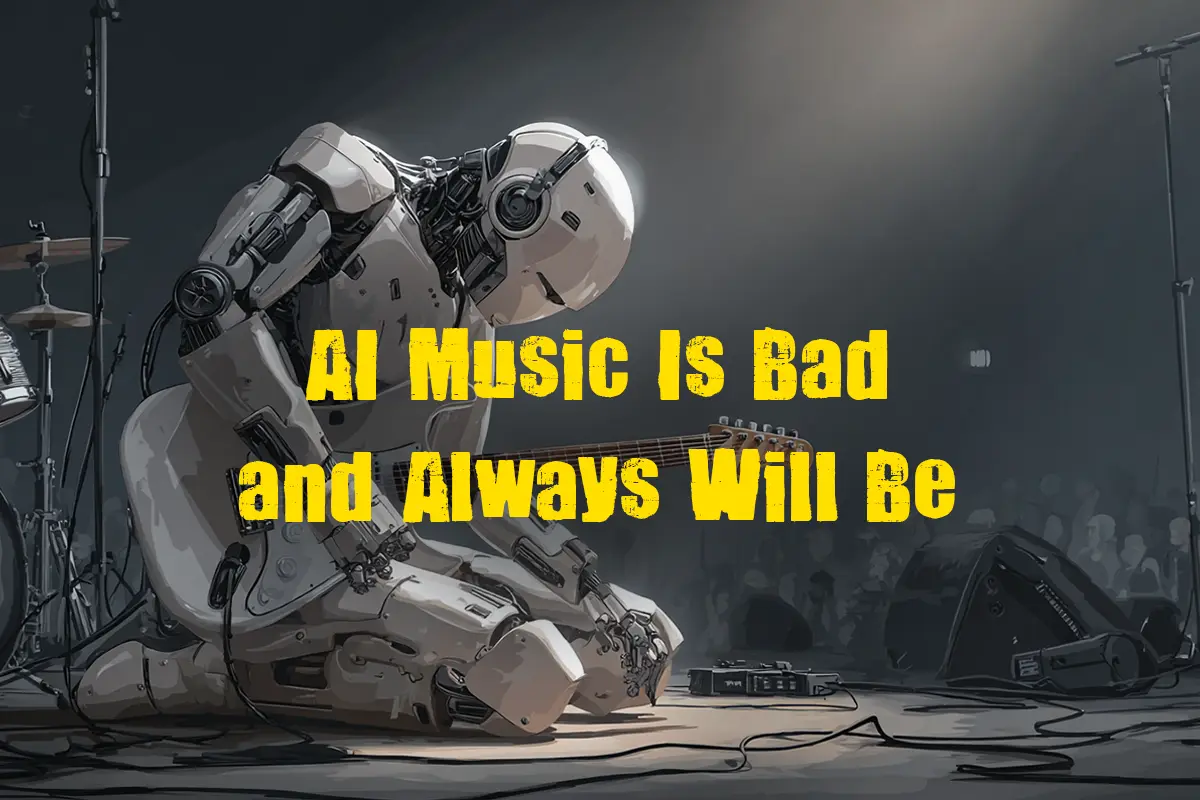
Why AI Music Is Bad. And Always Will Be
If you love music, chances are you’ve already stumbled across songs “written” and “composed” entirely by AI. And here’s the wild part, you probably had no idea they were made by AI while you were listening. But even if you did, you almost certainly don’t remember any of them now.
Because here’s the thing – AI “music” is totally forgettable. Shallow. Empty.
Sure, AI is the hottest topic around right now, and it’s going to stay that way for the foreseeable future. Same with the buzz around AI-generated music. But here’s my bet: just like this music is no good today, it’s never going to be anything significant or game-changing.
While AI excels at tasks that are programmable and predictable, the kind of stuff you can break down into rules and logic – it can’t create real music. Because you can’t program that. You can’t fake creativity. You can’t code feelings. You can’t write an algorithm for the goosebumps a beautiful song gives you. AI has no emotions, so it can’t re-create them.
How “Good” AI Music Actually Is
Just in case you haven’t been exposed to such “music,” I’ll give you a few notable examples. These are the most popular songs on Spotify that we know are AI-generated. Here, check them out for yourself:
Among these “bands,” The Velvet Sundown made a lot of noise in particular after multiple news outlets wrote about the project. They pointed out how this AI creation gained hundreds of thousands of streams on Spotify, with the platform even including it in their official playlists – thus cutting off real artists from potential exposure. I’ll talk about this in a moment, as it’s a significant move. But let’s look into the music first.
At first glance, AI-generated music does sound OK-ish. I mean, I’ve heard far worse things, for sure. These AI tracks are just your regular pop-style melodies with indie vibes and soft tunes. Or mediocre rock-ish songs. Or light jazz-like melodies. It all depends on the genre AI is trying to simulate. Overall, this is something you could easily find anywhere else. But the devil is in the details.
I want to point out three major AI generated music telltale signs that make it instantly unappealing:
- Lack of emotion – The most obvious characteristic of AI-generated music is that it’s pretty shallow. There’s no storytelling dynamic, no emotional roller coaster (in the good sense) in any of those songs. It’s empty both lyrically and musically. The main goal of AI music is simply to be listenable, nothing more. It’s not trying to tell a story. It’s super predictable and safe, so it evokes zero emotional response.
- Musical mediocrity – Another characteristic of AI music is that it offers zero interesting musical choices. There’s not a single moment that makes you want to rewind and hear a part again because it’s unusually beautiful. No, every section feels like a recycled fragment of something you’ve heard thousands of times in other real songs. That’s because AI doesn’t invent – it just copies patterns.
- Low sound quality – This one’s easy to spot. AI music almost always sounds worse than the real thing. There’s a strange noise lurking in the mix. You can hear it in both the vocals and the instruments if you listen closely. Split the track into parts, like Rick Beato did in his recent YouTube Video, and those artifacts become impossible to miss.
AI at its best is just a bundle of lower-quality sound bites stitched together to fake a real composition. Once in a while I’ll think, “Hm, that’s a nice little sequence of notes.” But those rare moments are just random bits cut from somewhere else.
Because the overall music is so unremarkable, you don’t really expect nothing from it anyway. You don’t get attached to it. You just accept it as a background musical noise.
So yeah – AI Music is not good at all. But will it get better in future?
Why AI Music Will Never Be Great
AI can be taught to do many great things – programming, data analysis, translations, calculations. It can be tasked with mimicking a lot of functions that the human brain can logically process. But AI can’t process emotions or feelings. And without being able to experience them, it can’t naturally express them either.
And what is real music, if not an expression of our emotions, our dreams, our passions — everything we call feelings?
Think of your favorite songs. What’s the first thing you experience when you think about them? If you’re not sure, just find one online and play it right now. I bet the first thing you feel is an emotion — a happy feeling, a joyful memory, maybe sadness, or even something dreamy. That’s what our favorite music does to us. Through lyrics, the voice of the singer, or the beauty of the melody itself – the greatest songs always evoke emotional feedback.
And that’s something AI can never replicate, and thus it will never be great at music.
Also don’t forget that right now AI isn’t truly intelligent – it’s just a complex system of code. And so it doesn’t care. AI performs a task not because it feels an unstoppable urge to express itself like humans do, but because it was told to. It doesn’t know if the result is great, because it can’t measure whether music is emotional.
When a real artist composes music, they work tirelessly and passionately to make it as close to perfect as possible. Current AI, on the other hand, can throw together something inhuman without a second thought. As long as the result satisfies some of the task’s parameters, it deems the job done.
Have you ever seen those freaky AI-generated images of people with seven fingers, two noses, and three legs? AI-generated visual art is a perfect example of how it copies the countless images it has processed online, but can’t tell if the end result is actually good. Same thing happens with music. AI is not creating something new – it’s simply executing code mechanically.
Sure, I can see that with time the quality of sound itself might get better, and there will be less artifacts, but that is juts a part of the problem – the lesser one for all that matters. AI won’t be able to solve Lack of emotion and Musical mediocrity.
Why AI Music Is Bad for the Industry
The main reason some people do enjoy AI music is that the bar for music in general is already set low. The industry isn’t improving with time – on the contrary, with the rise of social media and the dominance of streaming services, overall quality and diversity have suffered.
And it’s not just my perception. Studies have explored how music has changed over the years. For example, a study published in Nature showed a clear shift toward simpler melodies, blends of similar sounds, and music that’s simply louder to mask its lack of depth.
Think about it. Where are the Doors, the Queens, the Frank Sinatras, the Led Zeppelins of today? The number of bands and solo artists has exploded, yet the number of truly iconic artists who’ve changed our lives hasn’t kept pace. There just aren’t enough revolutionary stars anymore.
Maybe you’ve noticed the trend of older bands surging in popularity among younger audiences. It’s not about nostalgia, that’s for sure. It’s because people discover, and are amazed by, how stunning music used to be. How different it is from the repetitive, often unoriginal stuff promoted today.
Today AI is helping keep the creativity and quality bar low. And the worst part? Industry giants like Spotify aren’t doing anything about it. Instead of promoting real talent and music created by real artists — the platform adds AI-generated bands to their mixes.
The only winners are those without actual musical talent who’ve figured out how to generate “music,” upload it, and make money from it. And when the spot on big streaming platforms is being taken by fake music, what’s the incentive for the real upcoming musicians to try get noticed? It’s a already an uphill battle as it is.
To Sum it Up
AI “music” is not creative, rather predictable, and emotionally empty. It’s mishmash of recycled patterns, with mediocre melodies, low sound quality, and zero originality.
Some people may listen to it on the background without paying too much attention just because today’s music industry has already lowered the bar — streaming platforms push repetitive, unoriginal content while ignoring true artistry. AI only drags that bar lower. It’s big net negative for music scene.